

Washington crossed. Will we?
The 13th installment of "The Cause" series

In this 250th year of the United States, I’m writing a series called “The Cause.” “The Cause” was the initial name of the war for the independence of the United States.
Here are the first, second, third, fourth, fifth, sixth, seventh, eighth, ninth, tenth, eleventh and twelfth installments.
Below is the thirteenth one.
America’s secular canon is without exception comprised of the immortal words of mortals rising in defence of freedom, liberty and equality. Their greatness combined an incandescent moral clarity at great moments of testing. The words endure and ring across the ages because, within them, are the story of America.
It’s an epic story.
There are no great speeches from the racists, Confederates, Klansmen, know nothings, lynch mobs, Bund or any of a dozen other lesser totalitarian movements that have sprung to life in America during our history. They’ve left behind rivers of blood, pain, suffering and oppression, but no great ideas or monuments to achievement.
The words that gave life to the Confederacy, Jim Crow and January 6th were poisonous and unworthy ones. They came from the lips and pens of America’s villains.
Today, these lies and poisonous words that seek division and disunity have found a home in the ideology of national conservatism and MAGA.
Where are the places to look for guidance and resolve in this moment of testing — one in which a political party in America has abandoned the American experiment, which is rooted in the democracy of a constitutional republic?
Thomas Paine came up with a phrase that became a name.
Paine was the first person to write the words “United States of America.”
He invented it. It didn’t exist before he wrote it.
The British Empire was the most powerful on earth when the phrase “an empire upon which the sun never sets” was coined, not long before the American Revolution.
Sadly, today, most Americans know little about the revolution that remade the world. It was an audacious undertaking, to say the least.
Rick Atkinson, the superb historian and author of “The Liberation Trilogy,” which is perhaps the finest telling of America’s involvement in the European theater of the Second World War written this century, has also written two of his three books in “The Revolution Trilogy,” which I also highly recommend.
The first book tells the story of the “shot heard around the world.” It tells the story of the American Revolution’s brutal first years, during which the “cause” was nearly finished. Morale was low, the army was ill-trained, poorly led, often shoeless and hungry. Congress was completely dysfunctional, and the newly declared country was broke.
The British Army was in pursuit when George Washington maneuvered his broken force to an encampment on the Pennsylvania side of the Delaware River. Less than six months had passed since the reading of the Declaration of Independence to expectant colonists in July. The Revolution was on the edge of being crushed. The situation seemed hopeless.
Thomas Paine wrote a series of 13 essays that he titled the “American Crisis.” They were signed with the pseudonym “Common Sense.”
The United States was born in crisis and has existed within the turmoil of humanity’s story for nearly 250 years. Nothing was preordained.
Then — like now — history was forged by courage and cowardice. There was no human behavior that wasn’t present at the birth of the United States, including all of the despicable ones that are on incandescent display within our current politics.
Sometimes it helps to think about the ignominy and disgrace of people like Stephen Miller, JD Vance, Lindsey Graham, Ted Cruz, Pam Bondi, Kristi Noem, Matt Schlapp, Tucker Carlson, and a few hundred others in a broader context.
Thomas Paine addressed this phenomenon during the early hours of the American experiment. There has been a cure for expediency, timidity, careerism, ambition and selfishness in the intervening years. The language will be a bit archaic to the modern ear, but read it slowly below and see the wisdom.
‘Tis true that these years of chaos have had an unexpected blessing. Everyone has gotten a chance to show everybody exactly who they are. The technological realities of 2026 make it so much more vivid than what would have existed in Paine’s day, but the impulses and human nature are identical.
‘Tis surprising to see how rapidly a panic will sometimes run through a country. All nations and ages have been subject to them. Britain has trembled like an ague at the report of a French fleet of flat-bottomed boats; and in the fourteenth [fifteenth] century the whole English army, after ravaging the kingdom of France, was driven back like men petrified with fear; and this brave exploit was performed by a few broken forces collected and headed by a woman, Joan of Arc. Would that heaven might inspire some Jersey maid to spirit up her countrymen, and save her fair fellow sufferers from ravage and ravishment!
Yet panics, in some cases, have their uses; they produce as much good as hurt. Their duration is always short; the mind soon grows through them, and acquires a firmer habit than before. But their peculiar advantage is, that they are the touchstones of sincerity and hypocrisy, and bring things and men to light, which might otherwise have lain forever undiscovered. In fact, they have the same effect on secret traitors, which an imaginary apparition would have upon a private murderer. They sift out the hidden thoughts of man, and hold them up in public to the world.
No truer words. The ignominy of men like Trump and his enablers is novel only in that their crimes are unique to them. The character of the players and their wretchedness is timeless.
During this first essay, Paine tells the story of a loyalist farmer and his daughter. The farmer says, “Well give me peace in my day!” Paine regards the man as an ungenerous parent, and in a sentence lays down an American ethos about sacrifice that has held from that moment until recently. It is the unwritten agreement between the American generations that Donald Trump and his enablers have smashed only recently:
If there must be trouble, let it be in my day, that my child may have peace.
Paine would likely have been astonished to learn that the American experiment, not only succeeded, but endured.
One of his contemporaries, a French nobleman, the Marquis de Lafayette, would later say that the spark of liberty that was lit in the new world would light the old. It did.
Perhaps it would have been beyond Paine’s imagination that one day American, Canadian and British troops would storm French beaches together against the greatest tyranny that the world has ever known. The American graves that lie above those beaches all face home towards land, across an ocean, to which none of them returned in a fight for human freedom against human slavery.
He would have understood the cause, and he would have understood the sacrifice. He wouldn’t have understood the lassitude of their grandchildren and a generation of privileged Americans who would surrender a birthright paid in blood to a Queens hustler and a cast of paw-licking ne’er do wells who want to establish a tyranny in place of the rule of law.
He would have understood the fear of the moment because fear was present at America’s beginning. It was everywhere when the cause seemed lost.
There is a similar sentiment that has run wild across the Democratic Party — with the exception of ‘Fighting Democrats’ like Jon Ossoff, JB Pritzker, Elissa Slotkin, Jason Crow, Ro Khanna and Jamie Raskin.
It’s the dogma of defeat and the gospel of pessimism. Those are a deadly combination when they combine in hours of crisis. They are the precursors of panic, and one thing has always been true: most people who drown can swim; they die because they panic.
Institutions and nations can also succumb to panic. They can succumb to pessimism. They can give into exhaustion, fatigue, helplessness and hopelessness. They can be overwhelmed by cynicism and corruption.
Paine addressed the moment that confronted our new nation and the pervasive fear of the people, army and Congress when all seemed lost in late 1776:
I thank God that I fear not. I see no real cause for fear. I know our situation well and can see the way out of it.
America has always burned with optimism. The promise of tomorrow has been fundamental to the development of the national character forged over 250 years of unequal progress towards the achievement of the noble ideals of July 1776.
Nations that can be unraveled by despair can be redeemed by hope and defiance. They can be reinvigorated by a spark and an idea.
In the moments where all seems lost, there comes a clarifying light. There are words that light the way and steady the nerves, calm the soul and clarify great purposes and causes. There are words that birth grit, resolve and a brutal determination to prevail against impossible odds.
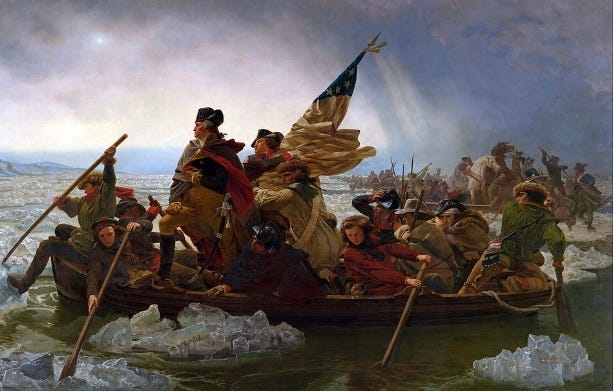
These words were published on December 19, 1776, as the bedraggled Continental Army, a rabble of untrained farmers — most of whom were nearing the end of their enlistments — huddled at the abyss of defeat in Pennsylvania. The frigid and ice-filled waters of the Delaware River were all that was keeping George Washington and his army alive.
He ordered the following be read out loud to the Continental Army on December 23, 1776. These are the words — as much as the Declaration of Independence — that gave birth to America. These are the words that saved America at twilight before our journey had even begun. The country, if it could be called that, was not yet six months old.
THESE are the times that try men’s souls. The summer soldier and the sunshine patriot will, in this crisis, shrink from the service of their country; but he that stands by it now, deserves the love and thanks of man and woman. Tyranny, like hell, is not easily conquered; yet we have this consolation with us, that the harder the conflict, the more glorious the triumph. What we obtain too cheap, we esteem too lightly: it is dearness only that gives every thing its value. Heaven knows how to put a proper price upon its goods; and it would be strange indeed if so celestial an article as FREEDOM should not be highly rated.
We live in a time in which the celestial has become common, cheap and corrupted by the lassitude of a people who have become estranged from the virtues that deserve celebration, remembrance and honor in a republic. That has no bearing on the inherent truths that Paine wrote about in his day and are essential for our time to conquer the threat ahead.
Today’s legacy media is often hypnotized by a chimera. There seems to be an intractable institutional delusion around the intent of the extremist cause. At best, it’s fueled by a lack of imagination and stubborn unwillingness to take both literally and seriously the words of the extremist faction that has declared its intent to obliterate American democracy to save their twisted and perverse version of freedom.
Much of America’s political media is ill-equipped for this moment of confrontation between American democracy and fascism. The transactional and access-driven stenography of Beltway reporters seeks a balance between democracy and extremism that’s unattainable. They can’t be balanced and reconciled.
The construction of so many stories emulates the absurdities of the peculiar culture of Washington, DC, which bops along in a predictable rhythm. It requires a certain permanence around carefully measured and balanced equilibriums that make possible absurdities like the White House Correspondents Dinner, incestuous book parties between subjects and authors, and dozens of other rhythmic rituals of the Washington calendar.
All of it is dependent on the great chimera that both political parties produce elected officials that, despite all of their disagreements, have more in common than in difference. This isn’t true. In fact, it’s a lie.
Freedom and a shared fidelity to the US Constitution was the common ground. It’s been breached, and there’s no place to meet in the middle. The threat comes from Donald Trump and the MAGA movement that controls the institutional structures of the GOP — lock, stock and barrel.
Again, Paine’s words from 1776 reach out to our own troubled times, and the nitwittery that flows freely now as it did then:
There are cases which cannot be overdone by language, and this is one. There are persons, too, who see not the full extent of the evil which threatens them; they solace themselves with hopes that the enemy, if he succeed, will be merciful. It is the madness of folly, to expect mercy from those who have refused to do justice; and even mercy, where conquest is the object, is only a trick of war; the cunning of the fox is as murderous as the violence of the wolf, and we ought to guard equally against both.
All Americans who love freedom should feel the deepest contempt for the hustlers, charlatans, cynics and opportunists who have attacked the Constitution in recent years under the MAGA banner. All American patriots should have a special contempt for the weakness and cynicism of the politicians who so easily, effortlessly and willingly got on their knees to service Trump.
Paine saw them clearly from long before they existed because he rejected their path so that America could be born. Here is what he said about the choice facing him and his deep comfort and gratitude about it:
Let them call me rebel and welcome, I feel no concern from it; but I should suffer the misery of devils, were I to make a whore of my soul by swearing allegiance to one whose character is that of a sottish, stupid, stubborn, worthless, brutish man. I conceive likewise a horrid idea in receiving mercy from a being, who at the last day shall be shrieking to the rocks and mountains to cover him, and fleeing with terror from the orphan, the widow, and the slain of America.
Defiance and resistance against injustice are at the heart of the American story. Every human vice and every virtue will be found in the American story. It is among the most exceptional in all the annals of human civilization.
When the American soldiers heard Paine’s words, they were on the edge of battle. They would soon cross the Delaware River on a frigid Christmas Eve.
They didn’t cross the river to spread peace and goodwill that Christmas. They came for freedom, and they took it at the point of a bayonet. Thank God for that.
Look at what they gave us. Let us defend it with half the vigor with which it was created.
It’s time to cross the river again.
It’s time to renew the American story in a great contest for the future.
Freedom is the strategy.
MAGA wants to take it away.
Are we worthy of the fight?
Are we collectively ready to hold the line and make a stand?
Are the American people ready to link arms with those with whom they disagree, in common defence around what we collectively cherish the most?
Is this generation of Americans the one that will let the experiment whither?
I wouldn’t bet on it.
Thomas Paine helped a young America find its voice. By doing so, he helped forge the national character and conscience of a fierce and free people:
If there must be trouble, let it be in my time, so that my children will know peace.
The question for the American people has always been what future do they wish to write.
Quitters don’t write the future, and history doesn’t remember their laments.
Steve's commentary today reminded me of a line from F. Scott Fitzgerald's the "Great Gatsby." "Americans, while willing, even eager, to be serfs, have always been obstinate about being peasantry." Populism on the right, MAGA, appeals to people who embrace serfdom. They believe in the right of a privileged class, usually backed by religious or secular dogmatism, to rule them. They want to be told they are better than the lesser people who create the hardships in their lives and they fawn over the ruling class they adore for giving them this praise and they believe this class has their best interests at heart, while that class exploits them mercilessly. In today's America, populism on the left, Democratic Socialists are like the peasants, who value nothing more than the right to enjoy their lives as independent and free citizens. They recognize the exploiting class for the villains they are and want to create a political, economic, and social system that provides the best life for all, restraining the worse aspects of capitalism and conserving the best through caring government interventions.
It is easier to be a serf than a peasant but ultimately the strength and determination of the free-thinking peasantry wins out, aided by the increasing depravity of a ruling class that causes so much pain among the serfs, as well as the peasants, that change becomes inevitable. It seems to be a pattern, repeating itself endlessly throughout all history.
Such a well written story. Thank you!