

FDR walked. Trump hid.
PLUS: "Dead Air:" sailors on the edge TODAY at 12 pm ET with Dean Blundell and me

Donald Trump, bruised, swollen, decrepit and wearing his wig, slinked off Air Force One and into an airline catering container.
He hid.
The president of the United States climbed into the machinery used to move airline meals because he was afraid.
There are images that reveal a presidency more completely than a thousand speeches ever could. This was one of them: Donald Trump concealed inside a catering vehicle, while the enormous blue-and-white presidential aircraft remained behind.
It was an image of fear. It was an image of indignity. It was an image of Donald Trump.
The degradation becomes more repugnant when measured against what Trump has demanded from Americans serving under his command.
The men and women aboard USS Abraham Lincoln have endured an extraordinary deployment at sea and in combat, carrying the consequences of decisions made by men sleeping comfortably thousands of miles away. The carrier has been deployed for more than 260 days and has gone more than 260 consecutive days without a port call – a modern record. Families and lawmakers have raised concerns about mental health, living conditions and the strain on roughly 5,000 sailors and Marines.
When the commander in chief was confronted with their circumstances, there was no empathy. No gratitude commensurate with their sacrifice. No recognition that sailors are human beings rather than pieces of government equipment.
There was contempt.
Trump said their deployment was “not nearly long enough:”
This is the Trump standard of courage: limitless sacrifice for somebody else.
It is matched by the incompetence of Pete Hegseth and a senior military leadership whose highest obligation is stewardship of the forces entrusted to them. The chief of naval operations is Admiral Daryl Caudle. Leadership means responsibility. Rank means responsibility. Stars mean responsibility.
If the crew is driven to this point, the admirals do not get to hide behind the deployment schedule. They own it.
Trump, Hegseth and their military leadership sometimes seem like characters transported out of a Saigon press conference and deposited in the present – as though some higher power decided that an American people drowning in lies required a reminder of what the military variety sounds like.
Mission accomplished. Progress everywhere. Problems nowhere. Just don’t look at the sailors.
Together, they have failed the United States, the American people, the United States Navy and the crew of USS Abraham Lincoln.
There is another way to measure them.
Eighty-five years and five days ago, on August 10, 1941, something remarkable happened in a Canadian bay named Placentia.
The United States was not at war. Britain was.
For almost two years Britain had stood against Nazi Germany. Poland had been destroyed. France had fallen. British soldiers had escaped across the Channel from Dunkirk. London had burned. Hitler controlled most of Europe. German armies were then tearing deep into the Soviet Union.
Winston Churchill came across the Atlantic aboard HMS Prince of Wales. Franklin Roosevelt arrived aboard USS Augusta.
The ships anchored near one another in Newfoundland.
Prince of Wales was no floating conference room. She was a fighting ship. She had already been bloodied in battle against the Germans. Only months before, she had fought Bismarck. German shells had struck her. Men aboard her had already experienced what combat meant.
Roosevelt knew it. He knew something else. They were fighting, while America was not.
On Sunday morning, Roosevelt went to them.
Churchill’s staff understood the American president’s physical condition. Arrangements had been made accordingly. Walking any meaningful distance was extraordinarily difficult.
Then word came from Roosevelt.
He would walk.
Franklin Roosevelt’s paralysis was not a secret. Americans knew polio had crippled him. Politicians knew. Reporters knew. Diplomats knew. Thousands of people who encountered him knew he used a wheelchair.
What Roosevelt fiercely protected was something different.
His dignity.
To understand what happened next, forget the word “walk” as you understand it.
Roosevelt could not walk.
His legs could not carry him.
To create the appearance of walking, steel-and-leather braces were strapped around them, and locked rigidly at the knees. Together, they weighed roughly 10 pounds.
Beneath his trousers were legs rendered largely useless by paralysis.
Above them was something altogether different.
Franklin Roosevelt was a large man, more than six feet tall, with a powerful upper body developed through 20 years of compensating for everything his legs could no longer do.
His shoulders were his locomotion. His arms were his balance. His back and abdomen moved his hips. His cane became another leg. His son’s arm became another.
Roosevelt sometimes called the peculiar method “stumping.”
On that Sunday morning USS McDougal carried the president across Placentia Bay toward Prince of Wales.
Picture it.
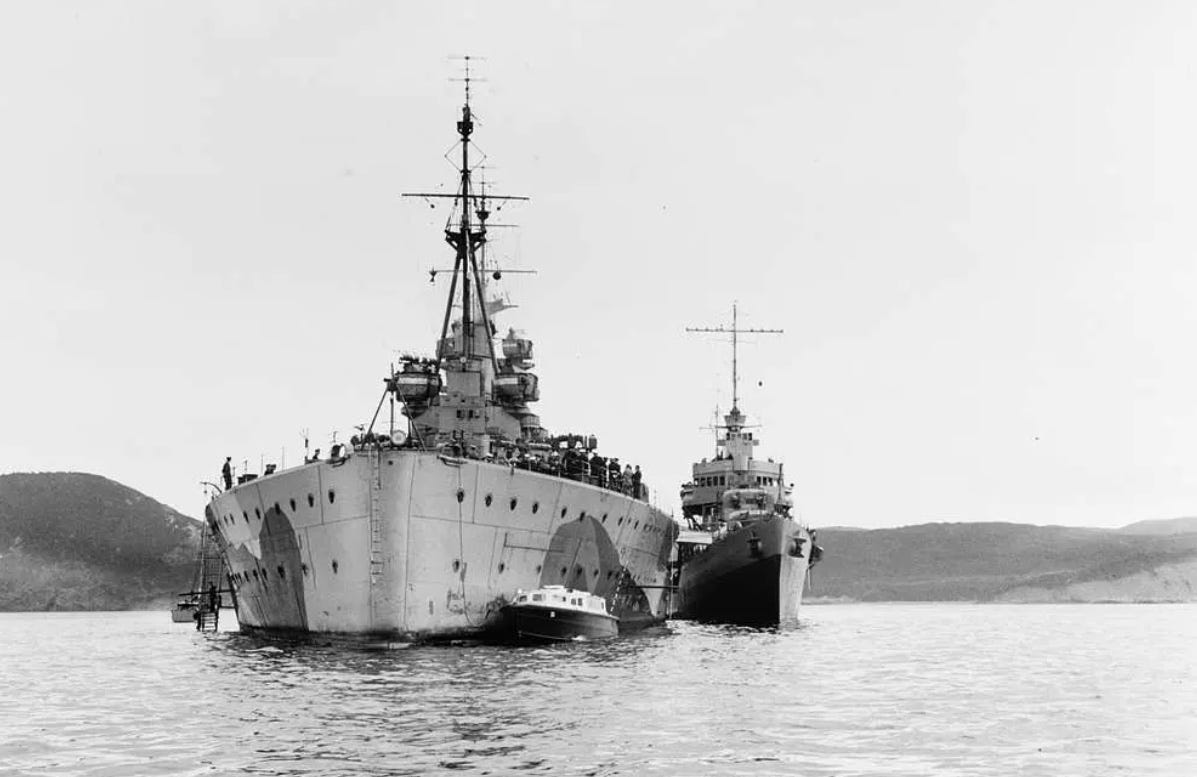
The American destroyer moves alongside the battleship.
Above, Roosevelt rises an enormous wall of gray steel.
British sailors crowd the rails. Lines are secured. The vessels move against the water. A gangway connects them.
Somewhere above are the great guns of Prince of Wales, weapons that had already fired against Nazi Germany.
And now comes Franklin Roosevelt.
His braces are locked.
Elliott Roosevelt takes his father’s arm.
The president grips his cane.
He begins.
First, he establishes his balance. Cane on one side. Elliott on the other. His useless legs locked underneath him.
Roosevelt tightens his grip. His shoulder bears down. His weight moves through his arm and into Elliott. His other arm loads against the cane. Now the torso moves. The muscles across Roosevelt’s back tighten. His hips rotate. One rigid leg begins to move. It does not step. It swings. The entire braced leg comes forward from the hip. Steel. Leather. Trouser cloth. Shoe. The foot moves across the deck. It lands.
That isn’t the end of the step. It is the beginning of the dangerous part.
Now, Roosevelt has to move his body over the foot. His shoulders shift. His weight transfers. The cane takes part of it. Elliott takes the rest.
For an instant, the president of the United States hangs between his son’s arm and a wooden stick, while two paralyzed legs locked in steel stand beneath him.
Balance. Hold. Recover.
Now the other leg.
Grip. Shoulder. Hip. Swing. Plant. Transfer. Recover.
A few feet have been crossed. There are more ahead.
Roosevelt does it again.
Cane. Elliott. Shoulders. Swing. Plant. Transfer. Smile. Again.
There is no hurry because there can be no hurry.
The British sailors watch.
Churchill waits.
The president keeps coming. One agonizing manufactured step at a time.
A British officer was there. Major-General Sir Ian Jacob watched Franklin Roosevelt cross that deck.
He could see what the president’s clothes normally concealed. Roosevelt’s legs, Jacob observed, were evidently wasted. He could see that Roosevelt possessed little control over them.
Then Jacob wrote one of the great understated sentences ever recorded about an American president:
It is a very great effort for the president to walk.
It took Roosevelt a long time to reach his chair.
A very great effort.
That is the whole story.
Because Franklin Roosevelt didn’t have to do it.
The accommodations existed. Everyone understood his condition. Nobody aboard Prince of Wales would have thought less of a paralyzed man for being carried.
Roosevelt chose to walk.
These were fighting men. Their country was bleeding. Some of the sailors watching him had already faced German shells.
Roosevelt understood that coming before them imposed an obligation upon him.
He would meet them upright – not because his disability was shameful – but because their sacrifice deserved his effort.
He moved the presidency across that battleship with his shoulders.
Eventually Roosevelt reached his chair.
Then came the service.
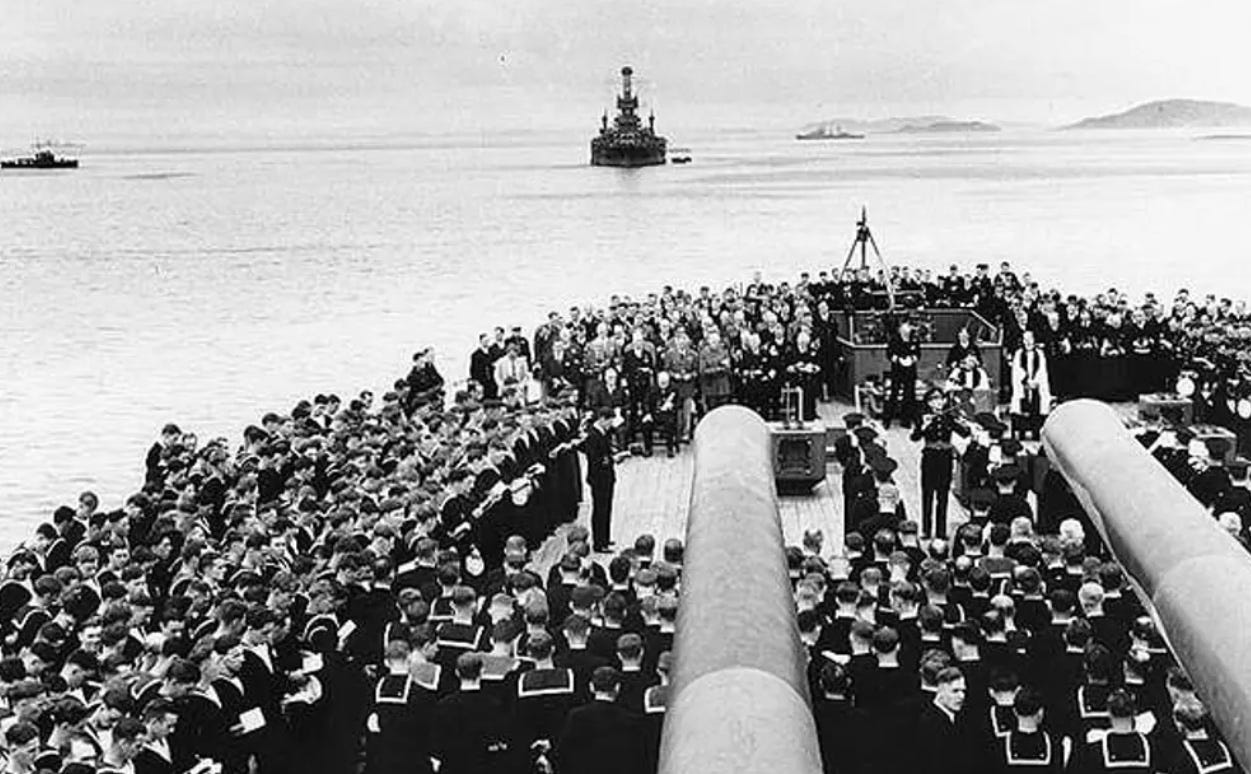
American and British sailors stood mixed together. British uniform. American uniform. British uniform. American uniform. Their officers were mixed as well.
The Union Jack and Stars and Stripes shared the scene.
Churchill sat beside Roosevelt.
The guns of Prince of Wales towered above them.
Then the sailors sang:
O God, Our Help in Ages Past.
Eternal Father, Strong to Save.
Onward, Christian Soldiers.
Churchill would never forget it. Neither would Roosevelt. Nor should we because Prince of Wales had four months left to live.
On December 10, Japanese aircraft found her off Malaya. Bombs and torpedoes tore into the battleship. She rolled over, and sank into the South China Sea. Hundreds died.
Some of the sailors who watched the paralyzed American president labor across their deck that August morning would never see another summer.
They didn’t know that yet.
They didn’t know Pearl Harbor was coming. They didn’t know America would enter the war.
They didn’t know Hitler would eventually be destroyed. They didn’t know Roosevelt would die before victory.
They knew only what they saw — an American president coming toward them.
Slowly. Painfully. Upright.
That is dignity.
Dignity is not a costume or swagger. It is not television toughness. It is not cruelty directed downward at exhausted sailors by powerful men living in comfort.
Dignity is understanding that leadership imposes obligations upon the leader.
Dignity is understanding that command is stewardship.
Dignity is knowing that the suffering of the people beneath you matters more than your convenience.
Dignity is Franklin Roosevelt looking across the deck at fighting sailors and deciding their sacrifice required something from him.
Franklin Roosevelt could not walk, so he walked.
Donald Trump can walk. He hid in the catering container.
That is the contrast.
One president confronted physical vulnerability every day of his adult life, and transformed it into empathy, discipline and courage.
The other has spent a lifetime constructing fantasies of strength, while demanding that other people absorb risks he will not.
One president looked upon fighting sailors, and asked something of himself.
The other looked upon exhausted American sailors and demanded more from them:
Not nearly long enough.
Remember those words.
Remember them when the men and women aboard USS Abraham Lincoln finally come home.
Remember them when the excuses begin.
Remember them when Hegseth boasts.
Remember them when admirals explain.
And remember another sound: a cane striking the steel deck of HMS Prince of Wales.
A shoulder tightening.
A rigid leg swinging.
A shoe landing.
A man’s weight beginning its perilous transfer.
Hold. Balance. Recover.
Then another.
And another.
Until Franklin Delano Roosevelt reached his chair.
Major-General Ian Jacob watched it happen. He understood exactly what he was seeing:
It is a very great effort for the president to walk.
Yes, it was.
That was why Franklin Roosevelt walked.
Then the president took his place beside Winston Churchill, surrounded by the sailors of two nations, aboard a battleship already scarred by war and soon to be swallowed by the sea.
And they sang:
Eternal Father, strong to save,
Whose arm hath bound the restless wave,
Who bidd’st the mighty ocean deep
Its own appointed limits keep;
O hear us when we cry to Thee,
For those in peril on the sea.
Eighty-five years later, the sailors of USS Abraham Lincoln remain in peril on the sea.
If we consider the fact that this is the elected leadership of the United States, we must understand that the United States is abandoning its military people serving abroad and on the seas, while spending $20 million at home to purchase electroshock gloves that will surely be used to torture women and children. Disgrace is not a sufficient enough word for this country.
This is an excellent piece