

"A night to remember"
PLUS: Join Bishop William Barber, Jonathan Wilson-Hartgrove and me TODAY at 3 pm ET on Substack Live

Tonight, I will be flying across the Atlantic Ocean on the anniversary evening of the sinking of the Titanic 113 years ago. I will be relatively proximate to her final location at the hour of her sinking.
I will be departing from Toronto, Canada, where no person in a nation of 40 million was snatched off of the street last night, stuffed into a white van, sold to an El Salvadoran dictator, and sent to his gulag. This is now America’s abiding shame.
The lessons from Titanic are enduring 113 years after her sinking, 350 miles off the Newfoundland coast on April 14, 1912. There are few tales of hubris, cowardice, recklessness, heroism, greed and extraordinary stupidity that equal hers.
She exists in memory as if she sailed recently. Her story is fresh because what killed 1,500 humans in the icy waters of the North Atlantic was a collision of greed, indifference and arrogance that opened the eyes of the world to the excesses of an age run wild that ended that night.
Some were carried to the abyss 13,000 feet down, where there is nothing but blackness.
Others floating, frozen solid, dressed in evening attire with lifejackets wrapped around them were hauled off the Atlantic’s surface by cable ships and other passenger liners for many months. They were brought to Halifax for burial.
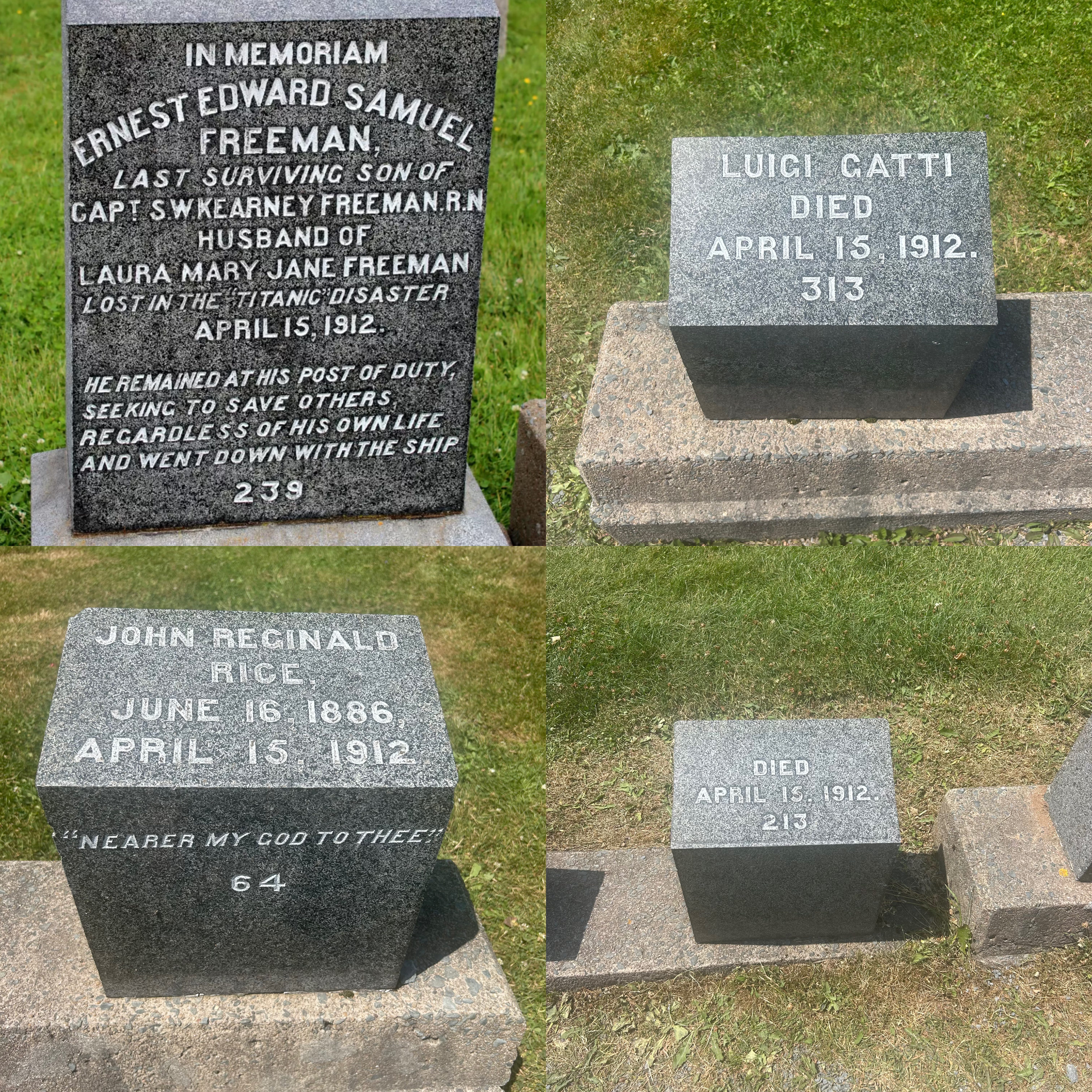
The dead were disproportionally made up of third-class or steerage passengers, some of whom were chained below decks behind fences to face death. The majority of them were Irish, as were the men who built the liner.
Bruce Ismay, the chairman of the White Star Line, was smeared in the media as having escaped his fate in a lifeboat dressed like a woman.
Conversely, Captain John Smith, who steered his ship into an ice field on a moonless night at full speed, was celebrated as a British hero.
It was widely and ludicrously reported that his last words from the bridge were “Be British.”
Soon after the disaster, the slogan was commercialized and emblazoned on scores of commercial products. The phony, tough and irredeemably stupid have always had a penchant for marketing.
The sinking of the Titanic ended the Edwardian age, and straddled the end and beginnings of new eras.
Two years later, World War I came.
It decimated the British aristocracy that filled Titanic’s first-class registrar in a simpler, grander, richer, decadent time that disappeared in an instant.
Here is how George Bernard Shaw wrote about the media coverage of the Titanic’s sinking. He focuses on the inclination for sensationalized and romanticized lying:
Why is it that the effect of a sensational catastrophe on a modern nation is to cast it into transports, not of weeping, not of prayer, not of sympathy with the bereaved nor congratulation of the rescued, not of poetic expression of the soul purified by pity and terror, but of a wild defiance of inexorable Fate and undeniable Fact by an explosion of outrageous romantic lying?
What is the first demand of romance in a shipwreck? It is the cry of Women and Children First. No male creature is to step into a boat as long as there is a woman or child on the doomed ship. How the boat is to be navigated and rowed by babies and women occupied in holding the babies is not mentioned.…
Women and Children First: that is the romantic formula. And never did the chorus of solemn delight at the strict observance of this formula by the British heroes on board the Titanic rise to more sublime strains than in the papers containing the first account of the wreck by a surviving eye-witness, Lady Duff Gordon. She described how she escaped in the captain's boat. There was one other woman in it, and ten men: twelve all told. One woman for every five men. Chorus: "Not once or twice in our rough island history," etc. etc.
Second romantic demand. Though all the men must be heroes (except the foreigners, who must all be shot by stern British officers in attempting to rush the boats over the bodies of the women and children), the Captain must be a superhero, a magnificent seaman, cool, brave, delighting in death and danger, and a living guarantee that the wreck was nobody's fault, but, on the contrary, a triumph of British navigation.
Such a man Captain Smith was enthusiastically proclaimed on the day when it was reported (and actually believed, apparently) that he had shot himself on the bridge, or shot the first officer, or been shot by the first officer, or shot anyhow, to bring the curtain down effectively. Writers who had never heard of Captain Smith to that hour wrote of him as they would hardly write of Nelson. The one thing positively known was that Captain Smith had lost his ship by deliberately and knowingly steaming into an icefield at the highest speed he had coal for. He paid the penalty; so did most of those for whose lives he was responsible. Had he brought them and the ship safely to land, nobody would have taken the smallest notice of him.
Third romantic demand. The officers must be calm, proud, steady, unmoved in the intervals of shooting the terrified foreigners. The verdict that they had surpassed all expectations was unanimous. The actual evidence was that Mr. Ismay was told by the officer of his boat to go to hell. Boats which were not full refused to go to the rescue of those who were struggling in the water in cork jackets. Reason frankly given: they were afraid. That fear was as natural as the officer's language to Mr. Ismay: who of us at home dare blame them or feel sure that we should have been any cooler or braver?
But is it necessary to assure the world that only Englishmen could have behaved so heroically, and to compare their conduct with the hypothetical dastardliness which lascars or Italians or foreigners generally - say Nansen or Amundsen or the Duke of Abruzzi - would have shown in the same circumstances?
Fourth romantic demand. Everybody must face death without a tremor; and the band, according to the Birkenhead precedent, must play "Nearer, my God, to Thee" as an accompaniment to the invitation to Mr. Ismay to go to hell. It was duly proclaimed that it fell out exactly thus. Actual evidence: the Captain and officers were so afraid of a panic, that, although they knew the ship was sinking, they did not dare to tell the passengers so - especially the third class passengers - and the band played Rag Times to reassure the passengers, who therefore, did not get into the boats and did not realize their situation until all the boats were gone and the ship was standing on her head before plunging to the bottom. What happened then Lady Duff Gordon has related, and the witnesses of the American inquiry could hardly bear to relate.
I ask, what is the use of all this ghastly, blasphemous, inhuman, braggartly lying? Here is a calamity which might well make the proudest man humble, and the wildest joker serious. It makes us vainglorious, insolent and mendacious. At all events, that is what our journalists assumed. Were they right or wrong? Did the press represent the public? I am afraid it did. Churchmen and statesmen took much the same tone. The effect on me was one of profound disgust, almost of national dishonor. Am I mad? Possibly. At all events, that is how I felt and how I feel about it. It seems to me that when deeply moved, men should speak the truth. The English nation appears to take precisely the contrary view. Again I am in the minority. What will be the end of it? for England, I mean. Suppose we came into conflict with a race that had the courage to look facts in the face and the wisdom to know itself for what it was. Fortunately for us, no such race is in sight. Our wretched consolation must be that any other nation would have behaved just as absurdly.
The modern GOP/MAGA party is the Titanic party.
It is similarly reckless, arrogant, deluded and headed for the ice in a fog of denial.
Imagine being aboard a sinking ocean liner on a cold April evening.
When the iceberg sliced into the hull and severed the water-tight compartments, there was barely a shudder.
After that short moment, no more damage would be inflicted on the ship.
The collision happened approximately 20 minutes before midnight, and the ship would reach the bottom of the frigid North Atlantic Ocean two hours and 45 minutes later.
Time matters in situations like this. Every second counts.
Time is life’s great equalizer. Its movement forward is inexorable, unstoppable.
Each moment that passes is gone, forever, while the next unwritten one offers infinite possibility.
Time is the glacier that carves the future.
The use of time is highly personal.
Its apportionment is foundational to happiness, and the decisions around with whom to spend it are keystones of life.
Basic human agency and liberty are deeply linked to time because time is the playing field upon which the great decisions of life are made.
Murder is a crime above all others because, at the core of the act, is the stealing of time.
Life and time are inexorably linked.
Great purpose and meaning can be found in short lives, while many long lives appear to be barren deserts, where wasted time and emptiness make their deposits.
Aboard the ship that marketers and media celebrated and proclaimed “God himself could not sink,” a great drama would play out on a stage of two hours and 45 minutes.
Time was invariable, while the consequences built into a frantic and chaotic conclusion that was inevitable from the moment of the barely-noted collision.
The Titanic lost electricity, snapped in half and went to the bottom of the ocean in 14 minutes in a dramatic conclusion, which inevitably becomes the locus of the story when it is memorialized and documented.
When the moments of chaos, agony and death are remembered, it is the ending that gets the most time.
It is the beginning though that matters.
It is at the beginning, when the outcome was certain but when decisions and actions could still determine who lived and died.
There was no urgency when the mostly empty first lifeboat was lowered into the frigid and placid North Atlantic 50 minutes after impact.
The ship’s designer was aboard and knew the ship was doomed – as did her Captain, who plowed it at full speed into an ice field on the orders of the CEO of the White Star Line, who was also aboard.
Predictably, it was the CEO who was the sole survivor among the three.
One-hundred minutes would pass between the lowering of the first boat and the chaotic moment when the electricity ceased.
There were no lifeboats left for the terrified passengers, who prayed for salvation that was theirs an hour and a half earlier.
Why didn’t they get in the lifeboat then?
It is an obvious but an unfair question because it is asked in hindsight and in a context where time is disassociated from the urgency that comes from fear.
Join me for my next live video TODAY at 3 pm ET
Yesterday, I introduced you to the latest edition to Substack — Our Moral Moment w/ Bishop William Barber & Jonathan Wilson-Hartgrove, which I highly recommend.
I will be speaking with them both at 3 pm ET TODAY, and I hope you’ll join us.
Simply download the Substack iPhone or Android app. You'll be able to watch our conversation in real time. A recording will be available if you’re unable to watch live.
This are open to ALL subscribers, whether paid or free.
If you haven’t already downloaded the app, you can do so here:
Is disappearing Venezuelans all that different from delivering disease-ridden blankets to America's original inhabitants and stealing their land? It seems like kindness and empathy are aberrations in America. We were founded on genocide, rape and pillage. They proudly called it Manifest Destiny in history books when I was a kid
Poignant observation and lessons from the Titanic disaster. Hopefully we’ll miss the MAGA iceberg, but we need to act now. Don’t let the bastards stay the course and ruin it all.