


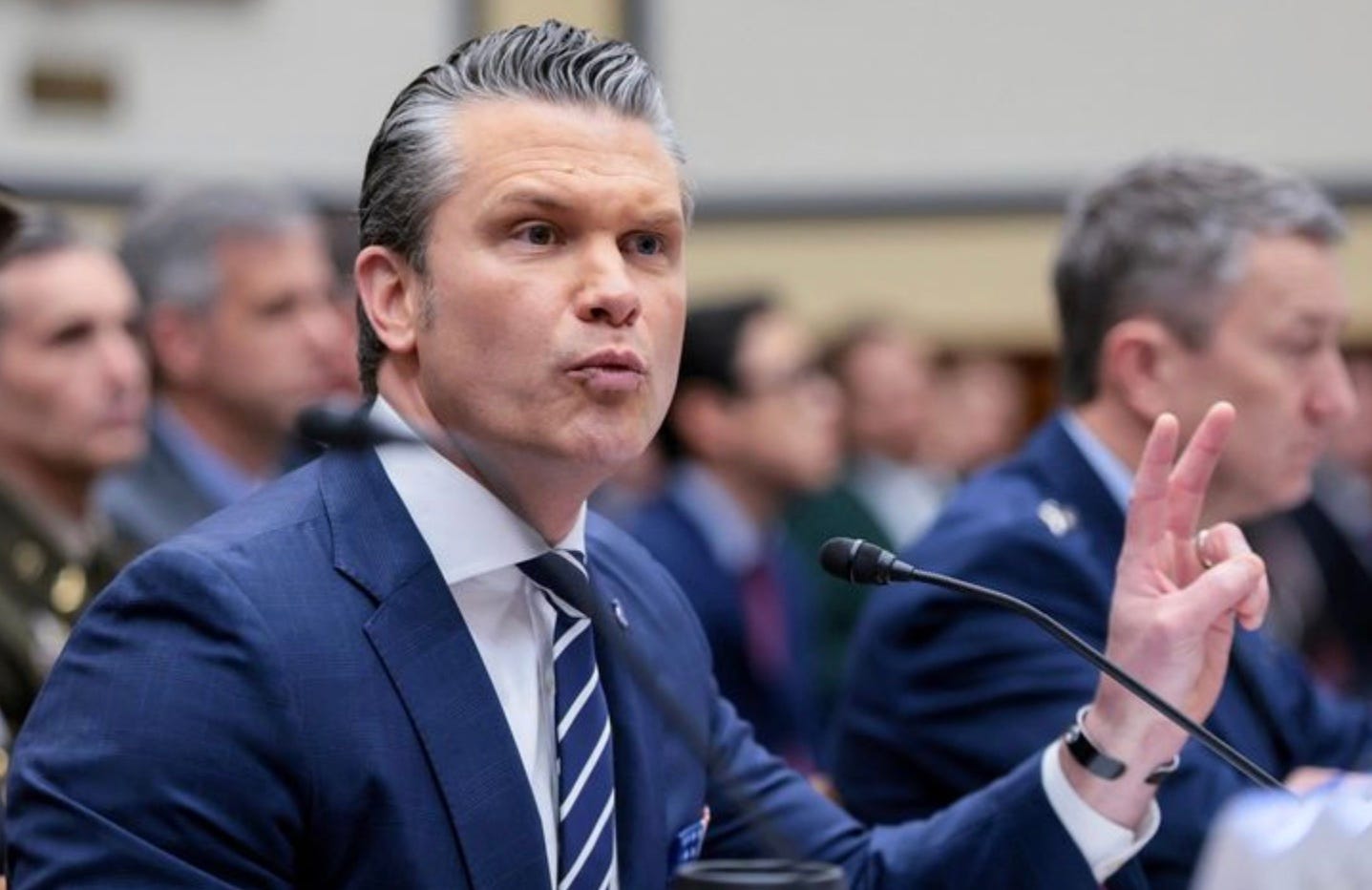
By invoking the title “Secretary of War,” Pete Hegseth hasn’t just revealed a preference for theatrical bravado over constitutional duty. He has revealed something more dangerous: a fundamental misunderstanding of the office that he holds.
America does not have a “Secretary of War.” It has a Secretary of Defense, bound by law, accountable to Congress, and subordinate to civilian authority under the Constitution.
What we witnessed this week in testimony during his first appearance before Congress since the Trump administration went to war in Iran wasn’t merely an embarrassment. It was a collapse.
There was the laughter — sharp, inappropriate, almost gleeful — when confronted with deadly serious questions about operational failures. When asked directly about breakdowns in command accountability related to recent military actions, Hegseth didn’t answer. He smirked. He deflected. He laughed as though oversight is a nuisance rather than a constitutional obligation.
There was the bluster. When pressed on intelligence gaps and strategic incoherence, he launched into long, meandering monologues about “strength” and “American dominance,” never once addressing the substance of the question.
Volume replaced clarity.
Posture replaced precision.
There was the arrogance. In multiple exchanges with members of Congress, when pressed on inconsistencies between prior public statements and his testimony, Hegseth didn’t clarify. He deflected. He interrupted. He talked over questions. He refused to concede even minor points of fact, treating oversight not as a duty to engage, but as a challenge to swat away.
And then there was the obstinance — perhaps the most dangerous trait of all. Repeatedly, he was given opportunities to clarify, correct, and to level with the American people. Repeatedly, he chose evasion. Direct questions were met with rehearsed talking points. Accountability was treated as hostility.
This isn’t leadership. It’s performance.
Performance, in matters of war and peace, is lethal.
Consider the words of Dwight D. Eisenhower, a man who understood both the machinery of war and the burden of command:
In preparing for battle I have always found that plans are useless, but planning is indispensable.
Eisenhower understood humility in the face of complexity. He understood that seriousness, not swagger, is the foundation of command. There was no humility on display this week. There was only a man convinced that confidence could substitute for competence.
Consider George C. Marshall, whose quiet authority helped save the world:
The soldier’s heart, the soldier’s spirit, the soldier’s soul, are everything.
Marshall spoke of character — of discipline, restraint, and moral gravity. Those qualities were nowhere to be found in Hegseth’s testimony. What we saw instead was theatrical indignation and a profound lack of seriousness about the human consequences of military decisions.
Then there is Douglas MacArthur, whose farewell to Congress still echoes as a warning to every civilian entrusted with military power:
Old soldiers never die; they just fade away.
MacArthur spoke those words in a moment of reflection, stripped of ego, acknowledging the limits of power and the inevitability of accountability. It was a speech grounded in history, sacrifice, and humility.
Hegseth’s testimony was the opposite. There was no humility. No reflection. No sense of stewardship over the lives entrusted to his command. Only ego — unchecked, unrestrained, and utterly unsuited to the office he holds.
The Department of Defense — or as Hegseth likes to call it, the “Department of War” — isn’t a television studio. Congress isn’t a green room. The American people aren’t an audience waiting to be entertained.
They’re owed the truth.
The men and women in uniform are owed leadership worthy of their sacrifice.
The Constitution demands accountability from those who wield power in their name.
What we saw this week was not just incompetence. It was contempt for the institution, the process, and the principle that no one in this country is above scrutiny.
The hearing room is supposed to be a place where truth is spoken plainly. Where power is checked. Where leaders demonstrate that they’re equal to the burden they carry.
Instead, it became something else entirely.
A stage.
A spectacle.
A circus.
There’s an old Turkish proverb that captures this moment with brutal precision:
When a clown moves into a palace, he doesn't become a king. The palace becomes a circus.
That’s what happened this week.
Predictably, Pete went Full Bondi.
In an administration populated with arrogant incompetents, Hegseth manages to stand out in both categories. It is difficult to imagine a person less deserving of mention on the same page as Eisenhower, Marshall and MacArthur.