

Explaining MAGA's obsession with art

For more than half a century, the Kennedy Center has made a priority of representing the rich diversity of American culture and has regularly celebrated artists of color and LGBTQ+ performers. That mission was thrown into doubt the moment Trump and his cronies took over its board. Now, the arts center would serve as a weapon in the president’s war against cultural elites.
Transforming—and MAGA-ifying—the arts have emerged among the president’s more surprising second-term priorities during his first 100 days.
— Excerpt from The New Republic, May 2, 2025, written by Dana Liebelson
________________________________________
The New Republic is a venerable magazine that has had good days and bad. It has been reinvigorated in this era of crisis by the moral clarity of its editor Michael Tomasky, and the excellence of its journalists, who are not kneeling, are not capitulating, and are not pulling punches.
Fearless journalism is an act of patriotism. It is love of country that will save America from MAGA.
American patriotism is far more powerful than American malice. They are in battle against one another as we speak.
The New Republic’s Dana Liebelson has looked into the MAGA obsession over the Kennedy Center, and has tried to explain it.
The story is important.
I’m going to try and explain the obsession.
There is something that you should share with your friends and family.
There has never been a demagogue who chased political power promising to imprison or kill people, who didn’t deliver when obtaining it.
Ever.
The goal of The Warning is to help readers orient to what is happening in the country through observations that blend a connection between current and historical events.
I try to help people decide something for themselves, and ultimately, take actions in defense of something deeply precious that we all share as Americans: freedom.
I don’t know about you, but when I walk around almost anywhere, a tremendous percentage of people have their heads buried in their phones. They appear oblivious and lost.
There is a place in Munich that I have visited many times. Last summer, I had the opportunity to take my son there to see what made such a big impact on me.
I wanted him to see for himself, and hopefully get what I was trying to teach him: the importance of seeing things for what they are, as they are, and being immunized from the lies that say the monster in front of you is harmless.
I want for him — and the rest of my children — to be aware.
The stereotypical “space cadet” used to be depicted as someone who had their head in the clouds, looking up and away.
Times have changed.
Distracted people don’t look up and away anymore; they look down and in.
The method doesn’t matter.
It is the costs of distraction that count.
It is important to be observant and present, which means it’s best to look both up and down.
This is a story about looking up.
It’s about art.
It’s also a story about control, power, ideology and madness.
I hope it might also make a point about freedom.
Some years back, I gave a commencement speech, and offered the new college graduates some wisdom from John Denver’s “Rocky Mountain High:”
I know he'd be a poorer man if he never saw an eagle fly.
The only way to see an eagle is by looking up.
Freedom of speech, religion and assembly are deeply rooted in the concept of human beings having natural rights to freedom of conscience, thought, and expression.
Even in the darkest and most terrible places, the human being creates and dreams.
Art is an expression of speech, thought, creativity and imagination, and therefore, it has always been political.
Because art is subjective and interpretive it has always been at odds with ideologies that seek to make human beings conform and submit to political authority that imposes truth, belief, opinion and aesthetic sensibility at the whim of the state.
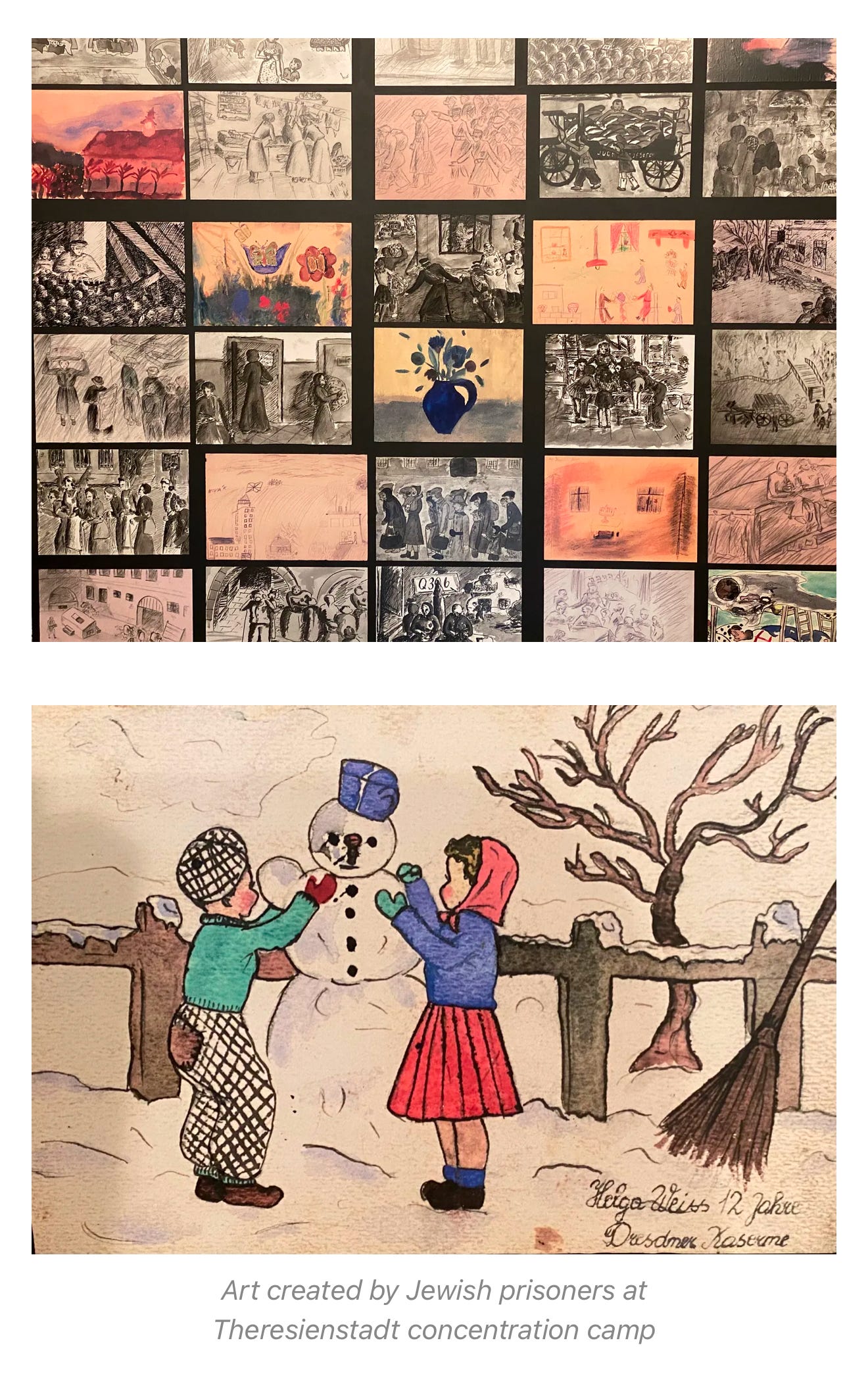
Fear has always been the weapon of choice for tyrants to impose conformity, stifle imagination and crush hope, and specifically, fear of execution, imprisonment or exile.
Books are a canvas for art.
Words are magical when conveying a picture, an image, experience, feeling, love and fear.
Books are a gateway to myriad other art forms, from painting, to theater, to motion pictures.
Without books the world becomes small and dark.
With books the world becomes full of possibility with learning, dreaming and imagination lifted to glorious places.
Books are the vessels of ideas — good and bad, righteous and evil, grand and petty.
There is no freedom without them.
Whatever wonder will be invented in the future, it will always be a descendent of the printing press, which lit the world far more powerfully than did electricity.
There was once a political leader who had strong feelings about art.
He objected to the “putrefaction” of society and the desecration of culture, values and society that came from its “degeneracy.”
He wasn’t the first — and won’t be the last — in a long line of anti-intellectual populists who believe that they are the arbiters of decency, and singularly gifted at rooting out “filth” on the basis of aesthetic genius, mixed with political power.
Here is what he said about what he called “degenerate art:”
Judaism had taken possession of those means and institutions of communication which form, and thus finally rule over public opinion.
Judaism was very clever indeed, especially in employing its position in the press with the help of so-called art criticism and succeeding not only in confusing the natural concepts about the nature and scope of art as well as its goals, but above all in undermining and destroying the general wholesome feeling in this domain....
Art, on the one hand, was defined as nothing but an international communal experience, thus killing altogether any understanding of its integral relationship with an ethnic group. On the other hand its relationship to time was stressed, that is: There was no longer any art of peoples or even of races, but only an art of the times. [...]
According to such a theory, as a matter of fact, art and art activities are lumped together with the handiwork of our modern tailor shops and fashion industries.
And to be sure, following the maxim:
Every year something new. One day Impressionism, then Futurism, Cubism, maybe even Dadaism, etc.
A further result is that even for the most insane and inane monstrosities thousands of catchwords to label them will have to be found, and have indeed been found.
If it weren’t so sad in one sense, it would almost be a lot of fun to list all the slogans and clichés with which the so-called “art initiates” have described and explained their wretched products in recent years…
Art can in no way be a fashion.
As little as the character and the blood of our people will change, so much will art have to lose its mortal character and replace it with worthy images expressing the life-course of our people in the steadily unfolding growth of its creations.
Cubism, Dadaism, Futurism, Impressionism, etc., have nothing to do with our German people.
For these concepts are neither old nor modern, but are only the artifactitious stammerings of men to whom God has denied the grace of a truly artistic talent, and in its place has awarded them the gift of jabbering or deception.
I will therefore confess now, in this very hour, that I have come to the final inalterable decision to clean house, just as I have done in the domain of political confusion, and from now on rid the German art life of its phrase-mongering.
Because the average American of the 2020s is less familiar with Cubism, Dadaism and Impressionism than with M&Ms, the battle lines have moved to candy from Futurism.
Yet, the battleground is the same as are the motives of the people who attacked Dadaism and Teletubbies, M&Ms and a hundred other totems.
The point is simple.
If people can be made to hate and fear candy and art, they can be made to fear anything, and more importantly, anyone.
The ability to inject fear into the veins of the body politic is a powerful weapon. It is an essential weapon for every tyrant there has ever been.
One lesson of history that should not be forgotten about Nazi book burning is where the bonfires raged.
They raged at universities. The people fueling the fires with the works of great philosophers, musicians, writers and artists were young people.
How does book burning start? Simple. With book bans.
That’s the first step.
We don’t talk often about ‘next’ in America.
We should.
When Adolf Hitler put a bullet in his head — after poisoning his dog and wife — the global war he started had killed more than 85 million people.
The American rebuilding of Europe and Germany into stable democratic societies was the greatest act of beneficence and generosity in world history by one nation for others, by one people for another, including their former enemies.
Today, Germany is a nation steeped in the rule of law. It is one of the most powerful nations on Earth, a force for stability, security and progress, a bulwark against Trump’s fascism, but even there, the furies are rising again.
Yet, the past is never far away in Germany.
The swastika is illegal in Germany — as it should be, as it must be.
When the war ended nearly every vestige of Nazi rule was eradicated.
The symbols of the 1,000-year Reich disappeared.
They were turned to dust.
There is a museum in Munich called the Haus der Kunst (“House of Art”).
The Nazis used it to display examples of “Jewish” and other degenerate art.
The museum survived the war.
After reunification in the 1990s somebody decided to look up one day at the inlaid ceiling mosaic under the portico. They saw an astonishing sight. There were swastika mosaics that covered the entire roof of the portico.
Every person who walked through the doors of the museum walked under those swastikas for more than 50 years, but no one ever looked up.
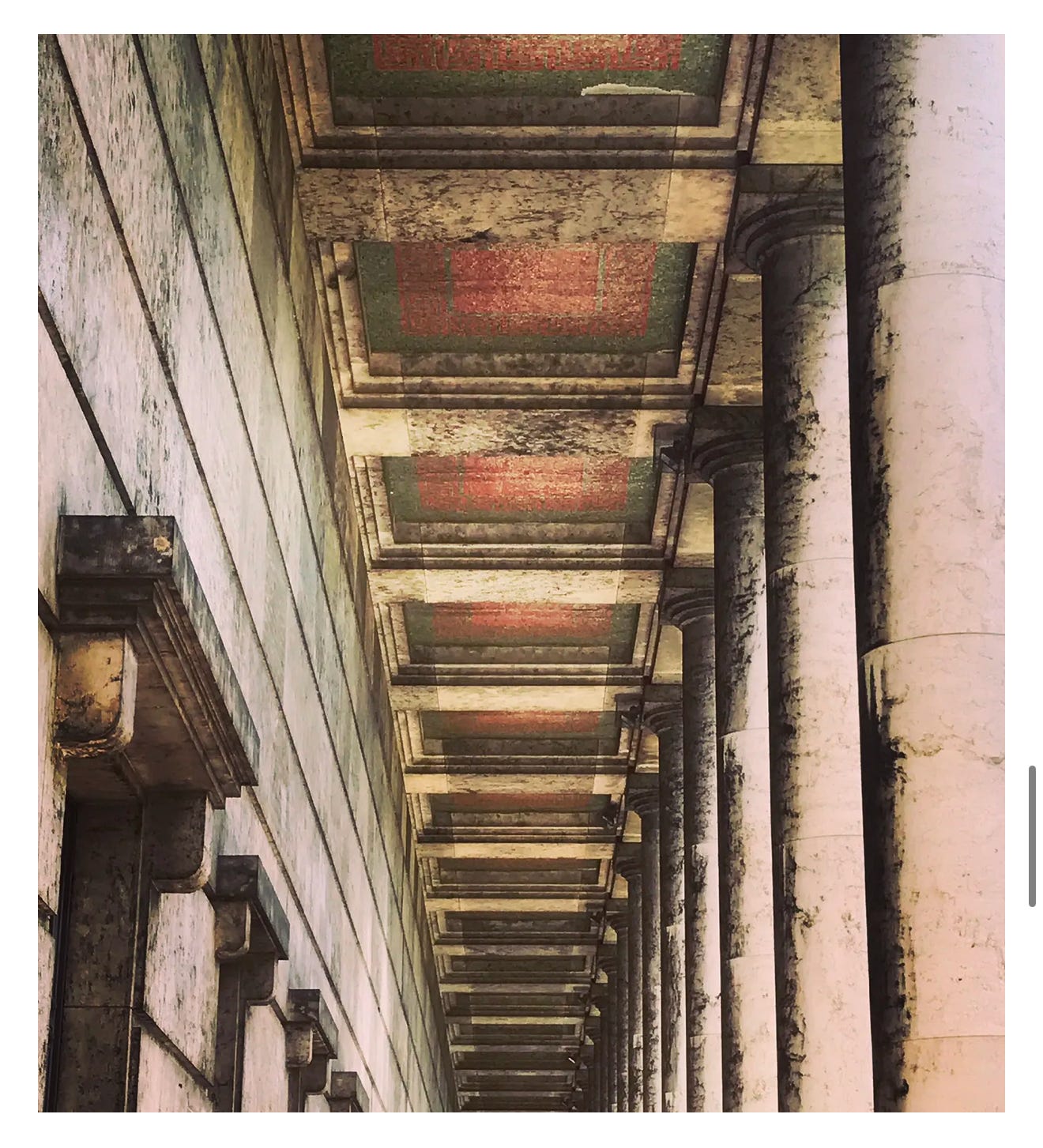
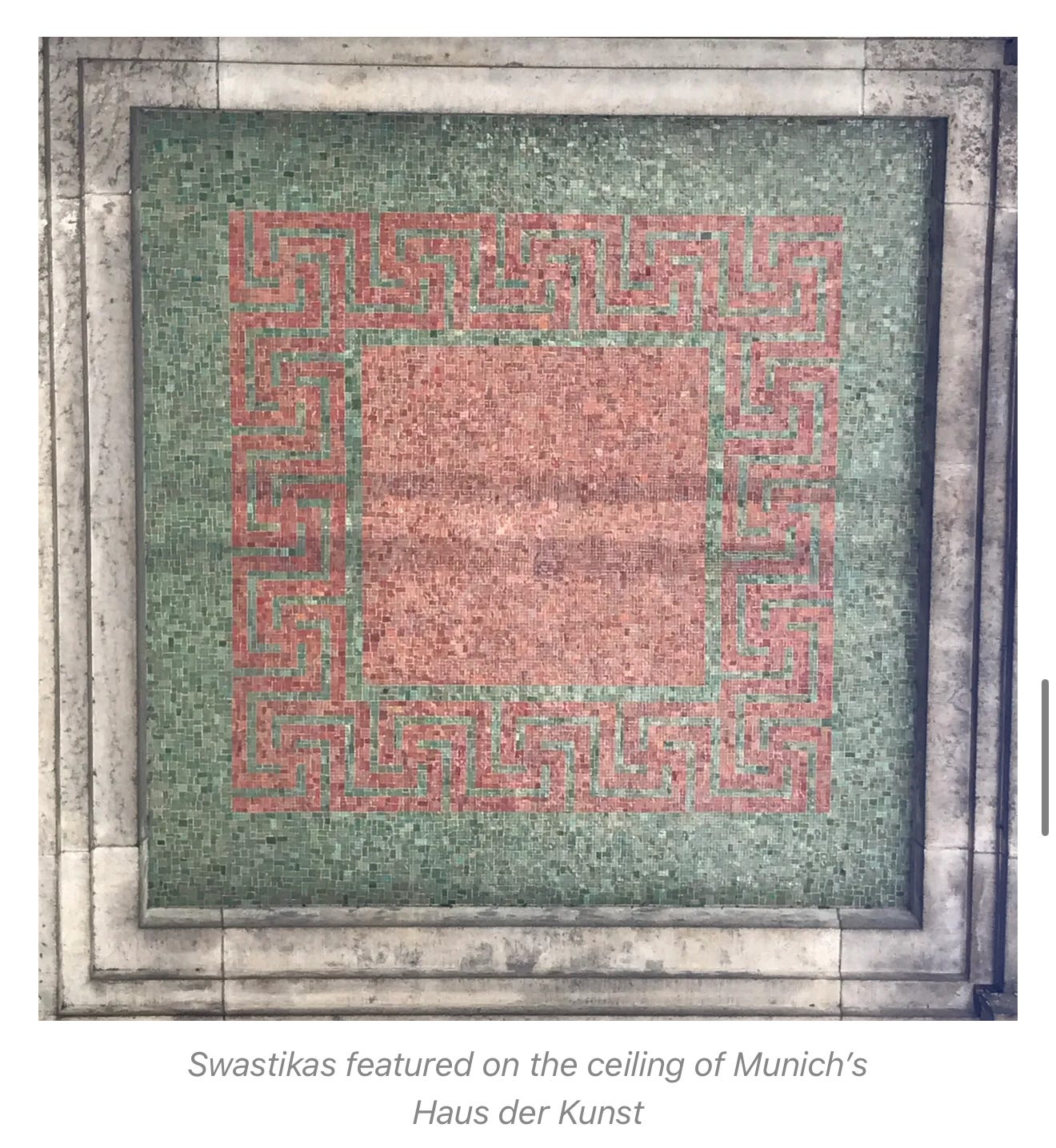
It’s good to look up.
It helps give perspective.
It helps orient an individual to what is happening in plain sight around them.
There is danger all around us, and it comes from the extremists amongst us.
Looking up helped remind me what it is we are looking at.
It’s something very ugly and very evil. It has nothing to do with books, sculpture, painting, or even M&Ms.
It has to do with power and control.
The best way to be controlled today is to keep your head down and eyes looking in.
That way you’ll never see what’s hanging over you —at least until it’s too late.
I'm certain the only "works of art" that appeal to Trump are phony touched-up AI generated portrayals of him and his colleagues in heroic poses. What a bad joke.
Trump is known to have never gone to the Kennedy Center when he was in office first term. Now, Trump is Chairman of the Board! Quite a turn-around? He has no knowledge of anything that reflects “culture.” Doubt Trump could sit still during a concert? Who is Bach, Mr. Trump?
Disgraceful display in every aspect! Kid Rock is his high reach?