

Artificial intelligence and the fate of democracy
PLUS: Join former Congressman Adam Kinzinger and me TODAY at 11:15 am ET

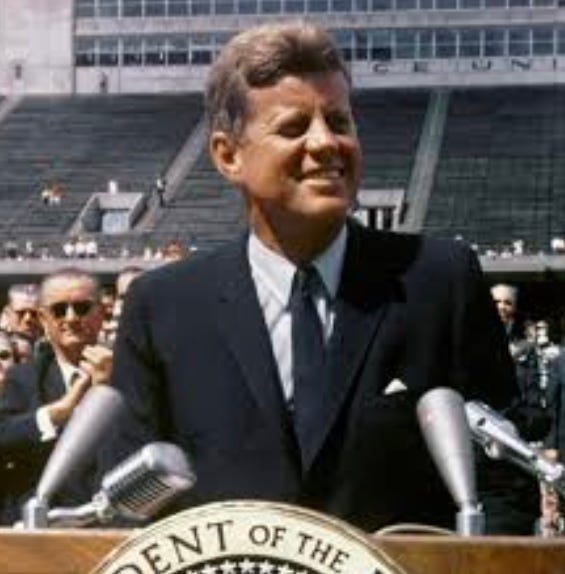
In 1962, John F. Kennedy stood before the American people and declared that the United States would go to the moon before the decade was out in a speech at Rice University.
Not because it was easy. Because it was hard.
Because hard things reveal nations. Hard things expose cultures. Hard things separate civilizations that still believe in themselves from those that have surrendered to comfort, cynicism and decline.
Today, America faces another moonshot.
It isn’t in the heavens above us. It’s in the invisible architecture forming around us.
Artificial intelligence is the defining force of the century.
It’s the force that will reorder economies, governments, militaries, education, labor, medicine, art, energy production, and the very meaning of human productivity itself.
Most Americans don’t yet understand the magnitude of what’s coming.
When Kennedy gave that speech at Rice University, if you compressed all of human history into 50 years, powered flight had only arrived in the final months.
The moon landing itself would have occurred in the final seconds.
Now consider this: if all of human history were compressed into one hour, the personal computer would arrive in the final minute.
The internet would emerge in the final seconds.
The smartphone would appear in the blink of an eye.
The iPad, cloud computing, social media, streaming technology, quantum processing, neural networks — all of it — would materialize almost instantaneously.
Now comes AI — not as another invention or gadget — but as a civilization-altering force moving faster than any technological transformation in human history.
Faster than electricity, the automobile, the television, and faster than the internet itself.
The pace is so extraordinary that entire industries are already being reorganized before governments have even begun to understand what they’re regulating.
Children using AI today will possess intellectual leverage unimaginable to the generations that preceded them.
Entire professions will disappear.
Entire professions will emerge.
The question isn’t whether this transformation is coming.
The question is: who will own it?
Who will control it?
Who will benefit from it?
And who will be crushed beneath it?
This isn’t merely a technological question.
It’s a moral question.
It’s a democratic question.
It’s a human question.
There are two competing visions emerging in the AI age.
The first is the oligarchic vision — a future where a tiny number of corporations and billionaire kings control the computing power, the data, the energy infrastructure and the intelligence systems that shape daily life for billions of people.
A world where ordinary citizens become economically disposable.
Where labor loses leverage.
Where surveillance deepens.
Where algorithms determine truth.
Where humanity slowly surrenders agency to systems it no longer understands.
That future isn’t science fiction.
It’s already forming, but there is another path — a democratic path.
A future where AI augments human beings instead of replacing them.
Where teachers become more powerful, not less relevant.
Where doctors diagnose disease earlier.
Where scientific breakthroughs accelerate.
Where energy systems become cleaner and more abundant.
Where ordinary people gain access to tools once reserved for empires and elites.
However, achieving that future requires something America has been avoiding for decades: seriousness.
Because here is the hidden reality behind the AI revolution: artificial intelligence isn’t only a software story.
It’s an energy story.
The AI revolution will require staggering amounts of electricity.
Data centers already consume enormous quantities of power, but what’s coming next will dwarf anything humanity has previously built.
Every AI query.
Every image generation.
Every autonomous system.
Every neural computation.
All of it requires massive, reliable and continuous energy.
The race for AI supremacy is, in reality, a race for electrical generation capacity, which means the countries that dominate the future may not simply be the countries with the best engineers.
They may be the countries capable of producing the most abundant power.
This changes everything.
It means nuclear energy returns to the center of strategic competition.
It means electrical grids become national security assets.
It means rare earth minerals, semiconductor manufacturing and power transmission lines become instruments of geopolitical power.
It means the AI revolution will reshape landscapes, labor markets and the physical geography of civilization itself.
Ordinary people are going to feel this transformation intimately — in their jobs, schools, electric bills, privacy, and their children’s futures.
The AI age isn’t arriving somewhere far away.
It’s arriving in kitchens, living rooms, hospitals, courtrooms, and classrooms, and eventually, inside every human interaction.
This is why the debate can’t belong exclusively to billionaires, venture capitalists and politicians performing for cable TV audiences.
The American people must decide what kind of civilization they wish to inhabit.
Do they want a society where technology concentrates all wealth and power upward into the hands of a tiny ruling class?
Or, do they demand a society where technological abundance expands opportunity and dignity for millions?
Kennedy understood something essential in 1962: great national projects aren’t merely engineering challenges.
They’re declarations of identity.
The moonshot said something profound about America.
It declared that democratic societies could still accomplish magnificent things — that free people could summon discipline, sacrifice and imagination for purposes larger than themselves.
Now history asks new questions:
Can America enter the AI age without surrendering its humanity?
Can democracy survive the age of machine intelligence?
Can freedom endure when truth itself becomes algorithmically manipulated?
Can ordinary people retain power in a world increasingly dominated by systems they neither built nor control?
Those are the defining questions of this century, and unlike the moonshot, there’s no distant lunar surface waiting for us.
There’s only ourselves — our wisdom, restraint, courage — and our willingness to decide whether technology will serve humanity, or whether humanity will slowly disappear beneath the systems it created.
What "could be" is an interesting question
Will the evil (greedy, power hungry) people control AI ? - or the will the "woke" (wanting to improve society for everyone) people control AI ?
The Technofascist leaders of AI have already convinced themselves they are in control, that we, the peasants, have neither the smarts nor the right to interrupt their vision of progress. I am not ready to surrender the environment, our democracy, or my mind to such craven goals. As the saying goes, “Who died and made you God?”